
Brand entities · Google Search · structured data
Build a clearer brand entity—not a guaranteed Knowledge Panel.
A Google Knowledge Panel can help people recognize an organization, person or place in Search. But no schema field, press package, Wikidata entry or agency can guarantee that Google will create or display one.
What you can controlAccurate website facts, structured data and authoritative profiles.
What Google controlsWhether a panel appears, what sources it uses and when it changes.
The practical goalMake your brand easier for people and machines to identify correctly.
Short answer
A Knowledge Panel is an information panel Google may show for a recognized entity. You can improve the clarity and consistency of your public brand information, and you may be able to claim an existing panel, but you cannot directly order or force Google to generate one.
01 · Understand the feature
What is a Google Knowledge Panel?
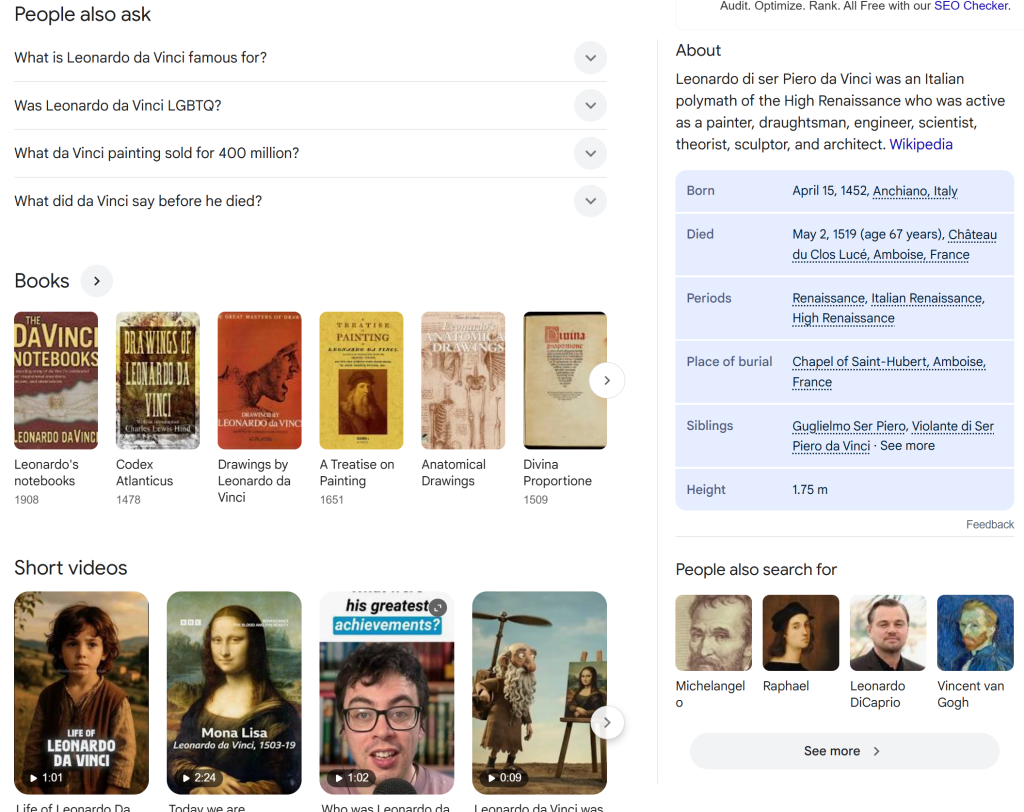
A Knowledge Panel is a search-result feature that summarizes information about a recognized entity. Depending on the query and device, it may include a name, description, logo or image, website, social profiles and other facts assembled from sources Google considers relevant.
A panel is not the same as a ranking certificate, a verification badge or proof that one business is more authoritative than another. It is also not a prerequisite for appearing in organic results or being mentioned by an AI system.
Google allows eligible representatives to claim certain Knowledge Panels. Claiming can provide a route for suggesting factual changes; it does not give complete control over the panel.
02 · Avoid category confusion
ENTITY
LOCAL PRESENCE
LOCAL DISCOVERY
Knowledge Panel, Business Profile and local results are different.
They can overlap visually, but they serve different search needs. Treating them as the same system leads to the wrong work and the wrong expectations.
Knowledge Panel
Summarizes information about an entity Google recognizes. Some panels can be claimed and factual edits can be suggested.
Google Business Profile
Lets an eligible local business manage operational information such as location, opening hours, photos and customer interactions.
Local results
Surface businesses relevant to a location-based query. Visibility can vary with relevance, distance and prominence.
03 · Build clarity systematically
1
2
3
4
A practical entity-strengthening workflow.
The work is less about “triggering a panel” and more about resolving contradictions across the brand’s official site and credible public sources.
Establish an entity home
- Use a clear About page for the organization.
- Publish the legal or trading name, location, contact details and leadership facts you can verify.
- Keep important facts current and accessible to crawlers.
Align official identities
- Use a consistent name, website URL and logo across owned profiles.
- Correct material conflicts rather than forcing identical marketing copy everywhere.
- Link only to genuine official profiles.
Add accurate structured data
- Use relevant
Organizationproperties on the home or organization page. - Make the markup match visible, verifiable page content.
- Validate the syntax before deployment.
Earn independent corroboration
- Prioritize relevant editorial coverage, industry profiles and original work.
- Avoid artificial citation quotas and low-quality syndication.
- Monitor branded results and correct errors at their source.
04 · Claims to reject
“A panel is guaranteed.”
“You need a fixed number of press links.”
“Wikidata is mandatory.”
“A panel guarantees AI citations.”
“Schema creates the panel.”
“Descriptions must match word for word.”
What responsible Knowledge Panel work does not promise.
Google decides whether and how the feature appears. Correct implementation improves clarity, not certainty.
There is no official 8-, 10- or 15-source threshold. Relevance, independence and factual consistency matter more than a manufactured quota.
It can be a useful source when an entity meets the project’s requirements, but it is neither appropriate nor necessary for every business.
Knowledge Panels and AI-generated answers are related to broader information systems, but no reliable rule makes one guarantee the other.
Structured data helps Google understand declared facts. Google explicitly says valid markup does not guarantee a search feature.
Core facts should agree. Natural descriptions can differ by platform without creating an identity problem.
05 · Technical foundation
Use Organization schema as an accurate machine-readable summary.
Google recommends adding relevant organization details and keeping structured data representative of the visible page. JSON-LD is usually the easiest format to maintain.
Important: Add only properties you can verify. Do not create social profiles, Wikipedia pages or Wikidata records merely to fill a
sameAs array. Do not mark up facts that users cannot find on the page.<script type="application/ld+json">
{
"@context": "https://schema.org",
"@type": "Organization",
"@id": "https://example.com/#organization",
"name": "Example Company",
"url": "https://example.com/",
"logo": "https://example.com/logo.png",
"description": "A factual description.",
"address": {
"@type": "PostalAddress",
"addressLocality": "Dubai",
"addressCountry": "AE"
},
"sameAs": [
"https://www.linkedin.com/company/example"
]
}
</script>
06 · Audit checklist
Check the evidence before chasing the feature.
Brand and content
- One canonical organization name is used consistently.
- The About page contains accurate, current facts.
- Leadership and author pages identify real people and roles.
- Important claims are supported by accessible evidence.
- Independent coverage is relevant and editorially credible.
Technical and monitoring
- Organization markup matches visible content.
- The canonical domain, logo and official profiles are correct.
- Markup passes syntax validation.
- Branded results are checked across normal search conditions.
- Known errors are corrected at the original source where possible.
07 · Frequently asked questions
Google Knowledge Panel FAQs.
Can I create a Google Knowledge Panel myself?
No direct “create panel” control exists. You can improve your official information and structured data. If Google already displays an eligible panel, an authorized representative may be able to claim it.
How long does a Knowledge Panel take to appear?
There is no official or dependable timeline. It may appear, change or disappear as Google evaluates information and the search context. Be cautious of anyone selling a fixed schedule.
Do I need Wikipedia or Wikidata?
No universal rule makes either mandatory. Both have independent eligibility, sourcing and community policies. A business should not create entries unless it legitimately meets those requirements.
Does Organization schema guarantee a panel?
No. It can help systems understand facts about an organization, but Google does not guarantee that valid structured data will produce a specific search feature.
Does a Knowledge Panel improve rankings or AI visibility?
It may improve brand presentation and factual clarity, but it should not be presented as a guaranteed ranking or AI-citation factor. SEO and AI-assisted discovery depend on many systems and signals.
What should I do if the panel contains incorrect information?
If you are eligible, claim the panel and use Google’s feedback options. Also correct inaccurate information on your official site and any source responsible for the error.
Entity clarity before promotion
Audit the facts shaping how your brand is understood.
We review brand naming, official profiles, structured data, editorial references and conflicting information—then prioritize corrections without promising a panel or AI placement.
