
• Home
  • Process
  • Services
    • Brand Mentions
    • Blogger Outreach Services
    • Digital Advertising
    • Product Design
    • Web Design / Development
  • Blog
  • About
  • Contact Us

11,000 Visitors. Almost No Sales. So We Stopped Chasing Traffic.

August 25, 2026Faisal NawazCase Studies & Insights

The Numbers Looked Good.
The Business
Said Otherwise.

Traffic was coming in. Ads were running. The dashboards were moving.
There was just one uncomfortable problem:
almost nobody was buying.

Instead of asking “How do we get more traffic?”, we asked a much harder question:
What exactly are we paying to bring to this website?
THE SHORT VERSION

11,000+ visitors forced us to stop asking for more traffic.

We connected Google Ads, Analytics, ecommerce data, Search Console and real on-site behaviour to find out why traffic wasn’t becoming customers.
What we found changed the strategy.

THE PROBLEM

When Marketing Looks Better Than the Business Feels

This is one of the most dangerous situations in digital marketing.

Nothing appears obviously broken. Google Ads is sending visitors. Analytics is recording activity. People are reaching product pages. Campaign reports contain enough numbers to fill a beautiful monthly presentation.

You could easily look at the account and conclude:

THE OBVIOUS ANSWER

“We just need more traffic.”

Increase the budget. Find more keywords. Launch another campaign. Create another audience. Push harder.

But there is a question that should come before all of those decisions.

THE QUESTION THAT MATTERS

What exactly are we paying to bring to this website?
Because 10,000 visitors with weak purchase intent can be worth considerably less than 1,000 people actively looking for what you sell.

Traffic is a number.
Intent is an asset.

11,000+
Website Users
?
Purchase Intent
↓
Sales Reality
THE DATA

11,070 sessions changed the Question

When we started looking deeper into the account, one number immediately demanded attention: 11,070 sessions.

That’s enough traffic to stop blaming everything on a lack of exposure. The website wasn’t invisible. People were arriving.

WE STOPPED ASKING
How can we generate more visitors?
WE STARTED ASKING
What are these visitors actually doing?

That took us outside the advertising dashboard. We started connecting the journey across the entire acquisition system.

FOLLOWING THE DATA
Google Ads
→
Analytics
→
Ecommerce
→
Search Console
→
User Behaviour

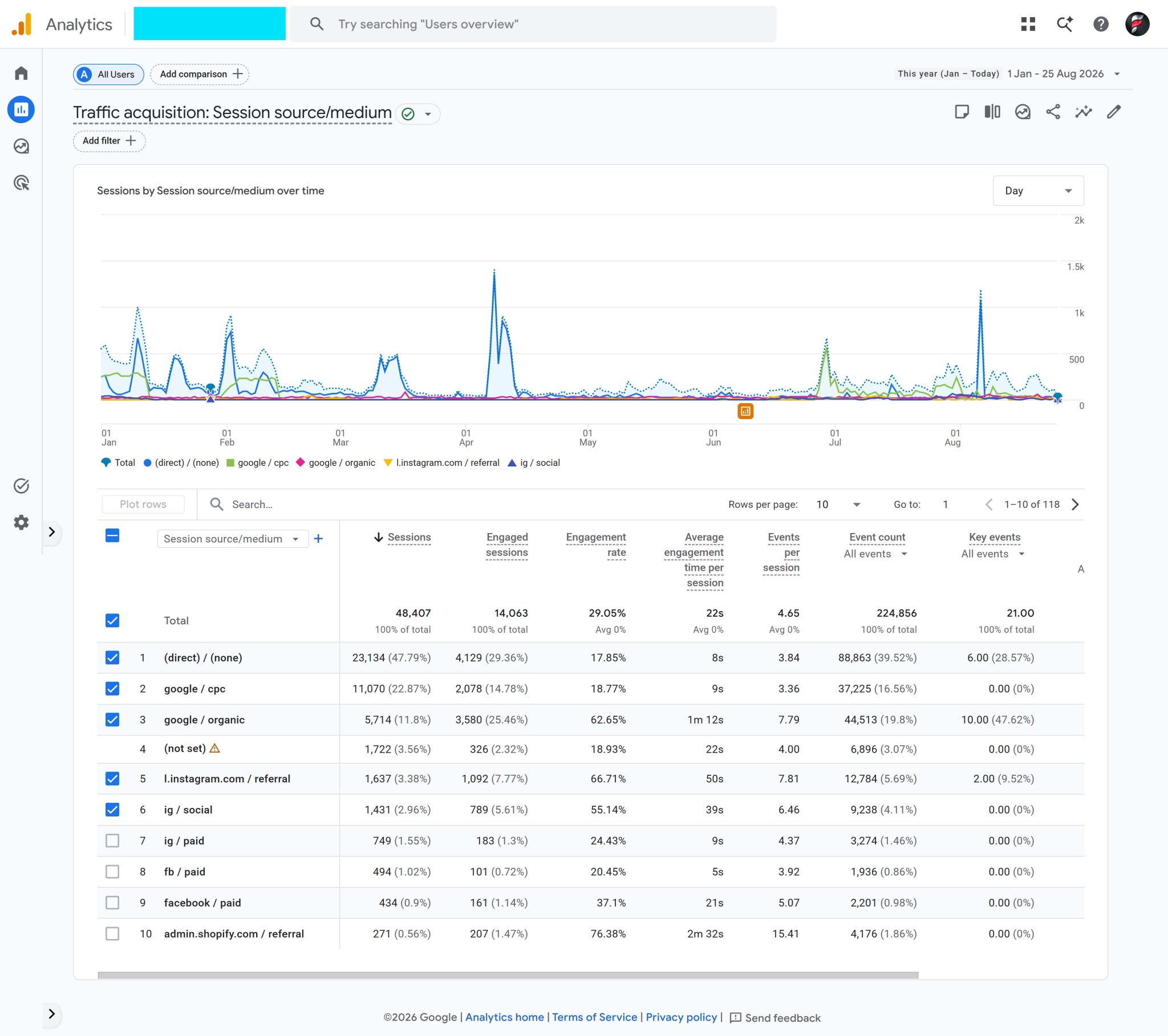
SCREENSHOT 01 — The Traffic Reality

Anonymised analytics data showing the scale of traffic being investigated.

Website traffic analysis showing more than 11000 users
Traffic looked healthy. Commercial performance told a different story.
CHANNEL QUALITY COMPARISON
METRIC Google / CPC Google / Organic
Sessions 11,070 5,714
Engagement Rate 18.77% 62.65%
Avg. Engagement 9 sec 1m 12s
Key Events 0 10

The signal was difficult to ignore:
paid search generated almost twice the sessions, while organic visitors showed substantially stronger engagement and recorded key events.

THE INVESTIGATION

We Followed the Customer.
Not the Campaign.

Digital marketing platforms naturally encourage marketers to think inside platforms.
Google Ads tells you about Google Ads. Analytics tells you about sessions. Search Console tells you about search. Ecommerce software tells you about orders.

THE PROBLEM WITH PLATFORM REPORTING

Each platform sees a piece of the customer.
The mistake is assuming one piece tells the whole story.

1. We Looked Beyond Clicks

Clicks are useful. They are not customers.
A campaign can generate thousands of clicks while producing very little commercial value.

AFTER THE CLICK, WE ASKED:
→ Did they engage?
→ Did they explore the product?
→ Did they compare alternatives?
→ Did they return?
→ Did they search the brand later?
→ Did they purchase?
→ Where did they hesitate?
→ Where did they disappear?

2. We Compared Traffic Sources

The behaviour wasn’t equal. Some channels generated considerably more traffic. Others showed stronger engagement. Some appeared to introduce people to the brand. Others appeared closer to the return journey.

THE ATTRIBUTION PROBLEM

The channel that introduces the customer may not be the channel that closes the sale.

Someone can discover a product through an advertisement, leave, research the category, watch a video, search for the company and return directly later.

BEHAVIOUR ANALYSIS

Then We Watched What Visitors Actually Did

Aggregated analytics tells you what happened.
Behavioural analysis can sometimes help explain why.

WE WATCHED

Actual customer behaviour

→ Fast exits
→ Product exploration
→ Product comparisons
→ Back-to-homepage behaviour
→ Repeated visits
→ Moments of hesitation
WHAT CHANGED

The sessions became people.

They weren’t just rows inside Analytics anymore.
They were people trying to make a decision.

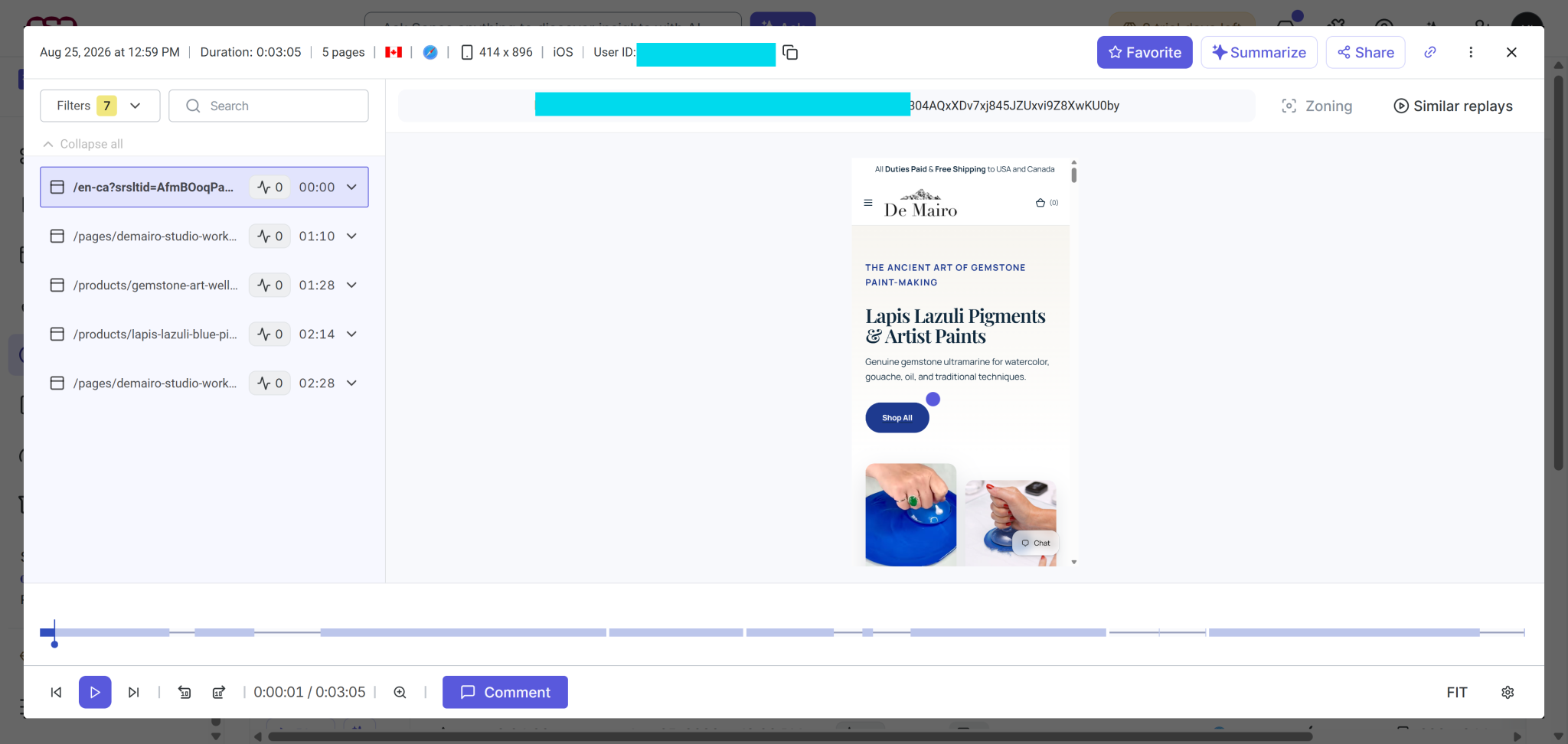
SCREENSHOT 02 — Behaviour, Not Just Traffic

Anonymised session behaviour showing how visitors explored the ecommerce experience.

Session behaviour analysis of ecommerce visitors

One session made the broader behaviour easier to see. Over three minutes, the visitor moved across five pages — from the landing experience into studio/workshop content, then into gemstone products and Lapis Lazuli, before returning to the studio/workshop section.

This wasn’t a straight conversion path. It looked more like a customer trying to understand the product, the process and the brand before making a decision.

WHAT WE DISCOVERED

The Product Needed More Than a Click.

The customer journey wasn’t:


Ad →
Product →
Buy

The buying journey required several things to happen before purchase intent became strong enough.

01
UNDERSTANDING

What is this product and why is it different?

02
EDUCATION

How does it work and why should I care?

03
TRUST

Is the brand credible enough for me to act?

04
INTENT

Am I ready to spend money on it now?

Paid traffic could create discovery.

But discovery wasn’t necessarily the same thing as purchase intent.

THE RISK

Buying more traffic could simply produce
more discovery without more customers.

THE BUDGET TRAP

The Most Dangerous Button in Advertising:
“Increase Budget”

When campaigns underperform, increasing spend can feel like action.
Sometimes it is exactly the right decision.
Sometimes it’s gasoline.

WHEN THE SYSTEM WORKS

Budget accelerates growth.

More money scales something already proven.

WHEN THE SYSTEM IS WEAK

Budget accelerates waste.

More money scales the problem.

BEFORE ADDING MORE BUDGET, WE WANTED ANSWERS
✓ Is targeting right?
✓ Is search intent right?
✓ Is tracking trustworthy?
✓ Is the landing experience working?
✓ Does the customer understand the product?
✓ Are discovery and conversion separated?
✓ Are visitors returning elsewhere?
✓ Is organic search capturing demand?
WHAT WE CHANGED

We Stopped Treating Advertising as the Centre of the Strategy.

01 — SEARCH INTENT

Not every keyword containing the right words contains the right customer. We separated traffic potential from commercial intent.

02 — ORGANIC SEARCH

Instead of interrupting a customer, search gives us the opportunity to be present when that person is actively looking for an answer.

03 — BRAND SEARCH

We started paying closer attention to branded search behaviour and the possibility that discovery was creating later direct and organic demand.

04 — CONTENT & EDUCATION

When customers need to understand a product before buying it, education stops being “blog content.”
Education becomes part of conversion.

05 — PAID MEDIA

Paid media still has a role. But every campaign now has to answer a harder question.

CAMPAIGN ROLE

What job is this campaign actually doing?

Discovery
Demand Capture
Remarketing
Brand Reinforcement
Direct Conversion

If we cannot explain the job of a campaign,
spending more money on it isn’t strategy.

FOLLOWING THE RETURN JOURNEY

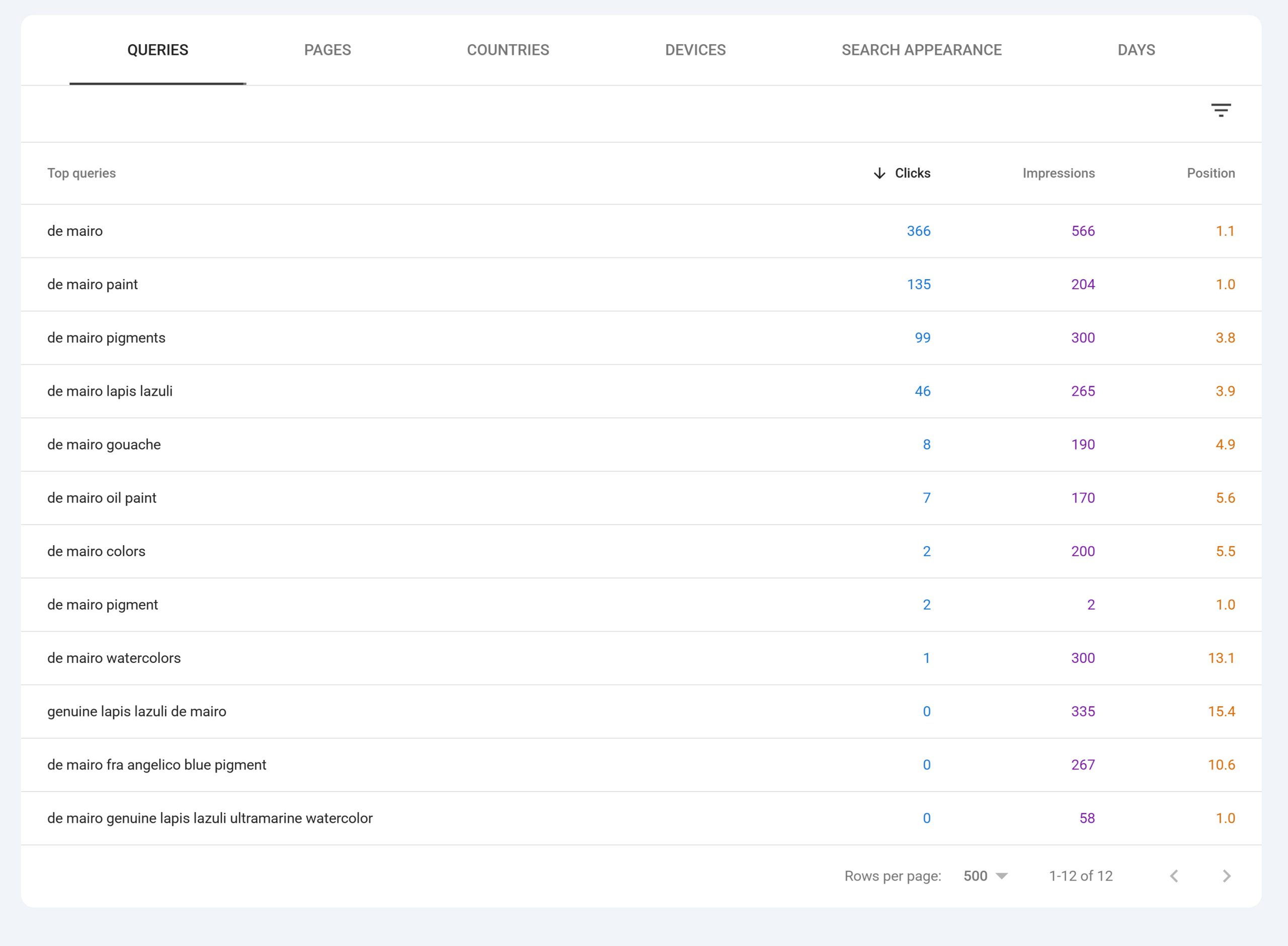
SCREENSHOT 03 — Looking Beyond Paid Traffic

The query data revealed something more interesting than branded demand alone. Searchers were combining the De Mairo name with specific commercial and product concepts — paint, pigments, Lapis Lazuli, gouache, oil paint and watercolors.

In other words, people weren’t only trying to find the company. They were increasingly associating the brand with the products and materials it sells.

Google Search Console branded search visibility analysis
Search can reveal demand that an advertising dashboard cannot explain by itself.

The strongest brand isn't only remembered by name

It becomes attached to the category in the customer’s mind.

Run Free Brand Footprint Audit
WHAT WE MEASURE NEXT

The Investigation Doesn’t End When the Campaign Changes.

That’s when the next experiment begins.

SIGNAL
Non-Branded Search
WHAT IT MAY INDICATE
Discovery
Educational Content
Engagement
Paid Media
Audience Exposure
Brand Searches
Growing Awareness
Returning Visitors
Consideration
Orders
Commercial Outcome

The goal isn’t to prove SEO worked.
Or Google Ads worked.
Or social media worked.

The goal is to understand what combination actually creates customers.

THE LESSON

Don’t Optimize a Channel Before You Understand the System.

Digital marketing has become incredibly good at producing numbers.

01
Impressions
02
Clicks
03
Sessions
04
CTR
05
CPC
06
Views
07
Conversions
08
Revenue / ROAS
DATA ≠ UNDERSTANDING

More data doesn’t automatically create more understanding.

A dashboard can measure activity. It cannot automatically tell you whether you’ve attracted the right customer, created trust, influenced future demand or built a profitable acquisition system.

Sometimes the most valuable thing an agency can do is stop.

× Stop launching.
× Stop increasing budgets.
× Stop celebrating traffic.
→ Start asking better questions.

Where did these people come from?
Why did they arrive?
What did they expect?
What did they do?
Why didn’t they buy?
Did they return?
Which part of the system moved them closer to becoming a customer?

That’s the difference between
managing campaigns
and
investigating growth.

FUTURISTIC ARTISTS

We Don’t Chase Traffic.
We Investigate Growth.

A dashboard can tell you that 11,000 people arrived.

The interesting question is:
Why didn’t they buy?

We connect paid acquisition, SEO, analytics, ecommerce performance and customer behaviour to find where growth is working — and where money is leaking.


LET’S INVESTIGATE YOUR GROWTH →
Faisal Nawaz
Faisal Nawaz is the Founder of Futuristic Artists and a digital growth strategist with over 18 years of experience building scalable online ecosystems. Since 2007, he has specialized in the intersection of branding, advanced SEO, and technical e-commerce development, delivering over 3,000 successful websites across diverse global industries. As an expert in entity-level optimization—including SEO, Answer Engine Optimization (AEO), and Generative Engine Optimization (GEO)—Faisal transforms traditional, traffic-heavy campaigns into high-converting, revenue-focused demand generation systems. Connect with him to bridge the gap between digital visibility and consistent business growth.
Previous post Google Knowledge Panel Optimization: The 2026 Guide to AI Search Authority

Let’s Talk

Want a successful start in global markets?

Give us a call, write us an email. we’ll get back to you to discuss your strategy
Contact Us
  • Home
  • Testimonials
  • Careers
  • Privacy Policy
  • TOS
  • Contact Us
  • Facebook
  • Twitter
© Copyright 2005 - 2026 Futuristic Artists. All Rights Reserved